

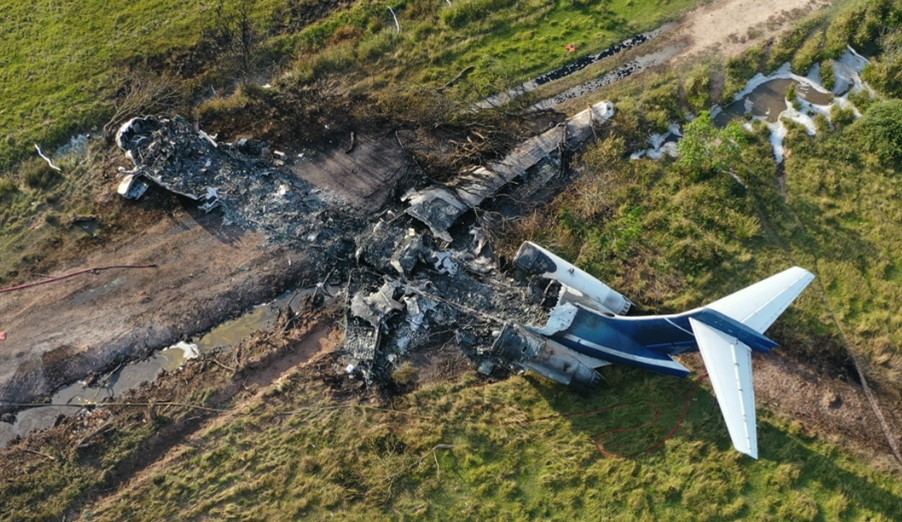
Recent events in America’s air transport system suggest that the system is becoming more prone to dangerous failures. Those failures include a January 29 mid-air collision between an Army helicopter and a passenger jet Washington, D.C.’s Ronald Reagan National Airport; a harrowing near miss between a landing passenger aircraft and an unauthorized business jet crossing the runway; a plane taxiing to the gate in Denver when an engine caught fire leading to the evacuation of all passengers, all of whom survived; and a blackout of air traffic controllers’ screens for 60 to 90 seconds at Newark Liberty International Airport.
The Associated Press compiled a list of recent incidents which can be found here.
No doubt problems have been brewing for some time in our air transport system. While most of the focus is on the air traffic control system, the aging system run by the Federal Aviation Administration, it is probably important to look at America’s overall aviation infrastructure which this year received a grade of D+ in the “2025 Report Card from America’s Infrastructure” from the American Society of Civil Engineers (ASCE).
And this highlights an important problem with how we look at infrastructure issues. We tend to focus on parts of it rather than looking at it as a whole in order to identify interlocking and systemic problems. For example, as this piece points out, Newark airport handles over 400,000 flights per year which is 11 percent fewer than John F. Kennedy International Airport in nearby Queens, New York. But the Newark airport is only half the size.
As for adding more air traffic controllers, something both the government and the union agree needs to be done, it’s not so simple. There is considerable attrition as new hires go through training and begin work. The work itself is highly stressful and requires much overtime (due to understaffing). Many new recruits drop out after a short time on the job. Systemic problems such as creating less demanding work schedules and better technology (some of the FAA’s system still relies on Windows 95 and floppy disks) cannot be solved piecemeal.
There is the question of whether a U.S. secretary of transportation who is a former Fox Business television host is going to be able bring transformational change to the U.S. air transport system. In fairness, Sean Duffy was previously a prosecutor for eight years and four-term Congressman. But, he is faced with a Congress which wants to cut spending, not appropriate large sums for remaking the air transport system. But this is a matter beyond my focus here.
The air traffic control system is not the only infrastructure system at risk. The American electrical grid may be subject to “‘elevated’ risk of blackouts this summer.”
The risk is elevated from Michigan all the way to the West Coast and south through the Mississippi Valley down to the southern tip of Texas. Parts of New England are also at risk. Extreme heat, if it arrives, could cause outsized demand for air conditioning and push electrical grids to the brink. The reason: There is not enough excess generating capacity to cushion such a surge in demand. Of course, with each day the continuing intensification of climate change makes such extreme heat more likely each summer.
We can take no comfort in the ASCE’s 2025 infrastructure report which gives the American energy infrastructure a D+. Electricity demand is now growing rapidly because of the electrification of transportation and the demand for data centers increasingly linked to artificial intelligence research and deployment.
Bottlenecks abound. For example, new sources of electricity must be connected to the grid. But this is not a simple process and has to be carefully planned and executed. Such connections now take on average 35 months to complete. Another example is transformers. Electricity needs to be delivered at voltages people can use, typically not those used to transport it long distances. That means transformers need to step down the voltage for household and commercial use. But there’s a long line for new transformers. Lead times range from 80 to 210 weeks (depending on the type of transformer). The average lead time is 120 weeks. It’s hard to move fast with a build-out of new electric generation with bottlenecks like these.
The previous administration’s infrastructure legislation set aside $13 billion to assist utilities in modernizing and expanding the electrical grid. But it’s not clear that this spending will continue under the current administration. Leaving critical infrastructure to rust, however, is asking for much bigger problems in the future.
These are just two of the major systems we rely on. If America faces a breakdown in one or both, the consequences in money and lives will be large. Complex, tightly networked systems such as these require constant upkeep and vigilance. Cascading failures can lead to long-term outages that can be devastating. Imagine, for example, if much of the American air transport system became paralyzed and stayed that way for a month. The damage would be unimaginable. And yet, we as a country have not seen fit to make the kind of investment necessary to assure the unimaginable never occurs. It behooves those who understand this to prepare accordingly.



Well, this is what collapse looks like. Just a handful of years ago, this all was "speculation" (if you're in denial) or simply difficult to predict exactly (if you're a realist). This (infrastructure stuff) is good – how can it be incorporated into quantitative prediction? The question is, how can the observed nonlinear changes in these (and tornados and wildfires, etc.) be used to get a feel, in advance, the rest of this decade? I don't think even Meadows nor Tainter/Patzek have clear ideas. In my mind, +2C could arrive by then (but that's just the average; it's consistent daily weather that supports large-scale food-crop production).
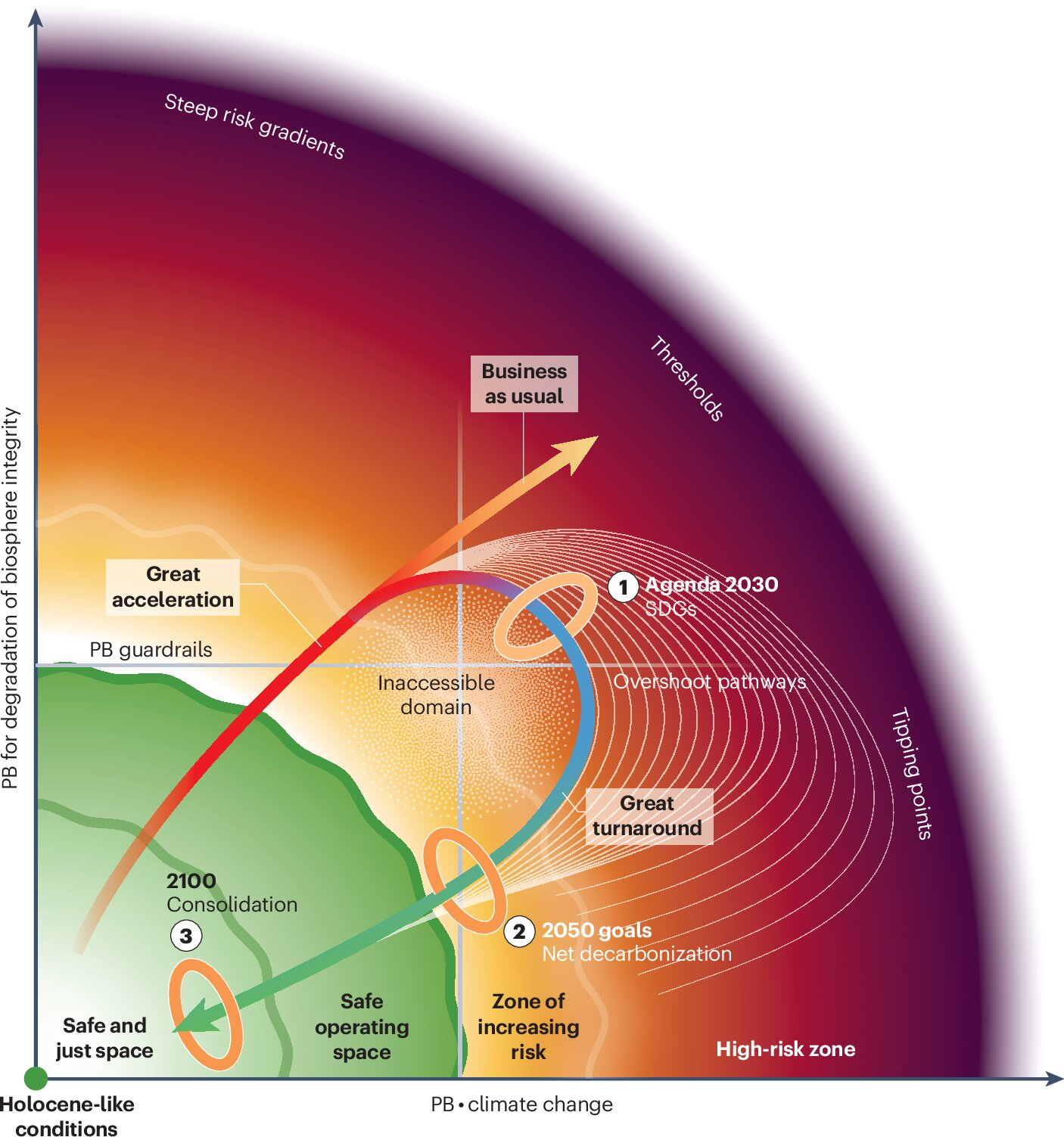
Planetary Boundaries [2024]
Can this really be accomplished in less than 5 years?
Note that the above assumes that a global average temperature (a number) equates to a functioning, self-sustaining, Holocene-like weather system.
Getting through the danger zone may be insufficient if tipping points (6 of 9) have been crossed.
It's not like "Top Gun" where an aircraft carrier is waiting at sea.
The failure to build and maintain infrastructure for growing industries reveals a contradiciton of liberal capitalism. An unimaginable disaster has already occurred. The train wreck and response to burn off the toxic spill in East Palestine were two combined disasters. Neither of which initiated institutional change or a popular response against the railroad operator and the EPA. Plutocratic governance views spending to improve infrastructure or environmental protection as a waste of surpluses which should accrue to the narrow interests of the dominant minority. Until a popular response to these manmade disasters becomes overwhelming, they will not stop. Expect them to accelerate.
Agree with the general sentiment of the article but as regards flying I understood that it was the canary in the mine and likely to be doomed to all but disappear in an energy poor future anyway. Time to revive your passenger railroad system perhaps, to obtain a system comparable to Europe (where passenger trains also invariably have priority over freight services and not vice versa, as I gather is often the case in the US).
There's a stagecoach leaving in 15 minutes.
I wanna be on it.
What is that painting in which our guardian angel is being blown backward
into the Future? I prefer Paul Klee's 1920 Angel Novus Walter Benjamin bought in 1921.
A storm is blowing from Paradise. Progress is reduced to a confusion of useless debris.
Our existence is finalizing because conditions are beyond the range of adaptation.
(global warming and resource exhaustion).
It's true that the Trump crew is all gaslighters, but we've been headed that way forever.
Right now they are cooking the books (science, history, economics) to try and prolong
the illusion. Many solutions we can conceive in our imaginations are no longer possible,
but we hope in vain. I toured Helene destruction recently, and I found the debris pile still accumulating.