

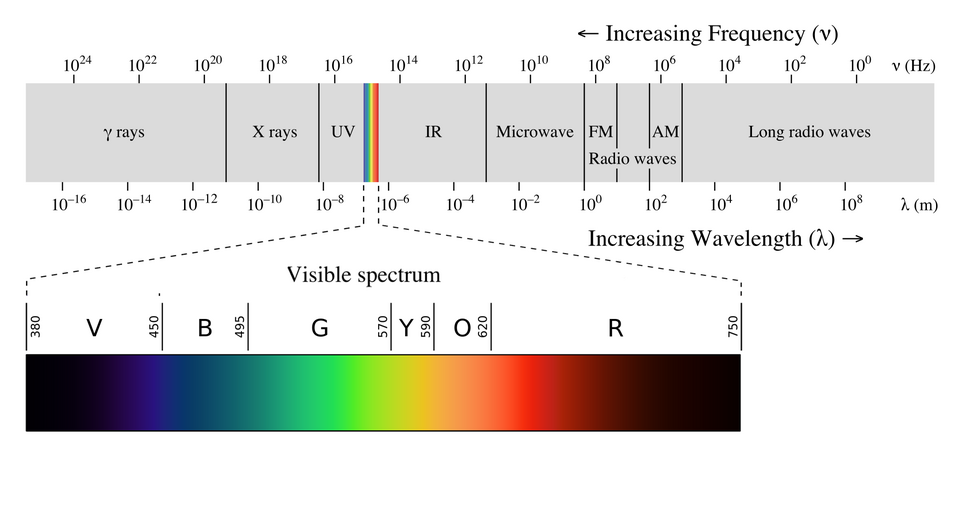
 The colors blue and red are used in the U.S. to represent political left and right, which at the extremes might be said to run from communism to fascism., Yet even that’s a tiny slice of the whole. (Image by Philip Ronan, Gringer; Wikimedia Commons)
We are accustomed to a left–right political spectrum. But said spectrum is only a tiny corner of the whole space of possibilities, even though practically everyone you know is wedged into it. Similarly, we use the word “light” to implicitly mean the narrow range of radiant energy that’s visible to human eyes, despite its being only a thin sliver of the full electromagnetic spectrum. All modern political schools share and support the context of an aberrant, exploitative modernity, making them real “birds of a feather.”
One window into political leanings is to elucidate an honest assessment of what one cherishes the most. But be careful about taking at face-value what people say they care most about. Sometimes they might even fool themselves. Below is a list whose scope (number of beneficiaries) increases as one moves down, and which might imperfectly map onto political leanings.
- Self/Ego
- Power
- Corporations
- Market economy
- Small businesses
- Families
- Welfare of all people
That’s usually where it stops, in terms of scope. Some might also care for the environment, but only insofar as people have access to clean air, water, food, and don’t suffer health maladies from pollution. The first item on the list doesn’t map cleanly onto left–right (no shortage of self-centered leftists!), but belonged on a list of what people care most about. One form that self-prioritization can take is personal salvation in a religious context.
Megalomaniacs, dictators, oligarchs, and authoritarians populate the top of the scale. Fascists also lean toward that upper end, as do—I would say—many MAGA Republicans in the U.S. Traditional Republicans occupy more of the middle range, while Democrats tilt toward the lower end. Marxists might be said to be all the way down. Yet, the demarcations are not clean, allowing funky mixtures. The overwhelming majority of political parties, for instance, work to support a vibrant market economy.
Ralph Nader ran for president of the U.S. in 2000, far enough to the left of George W. Bush and Al Gore that he characterized the two as “Tweedledum and Tweedledee”—implying a nearly inseparable twinness to the two. From far enough away, that’s what it looks like. A radical leftist or rightist will see all establishment politicians as muddled enablers of a dysfunctional system.
Where do I fall on this spectrum—or am I even on it? I’m going to make you wait for a short bit.
We might also try assigning percentages, crudely, to the groups above. If the primary cherished unit is oneself, one out of 8 billion people is the “top” 0.00000001%. Numero uno! Corporations—the wealthy and powerful—might represent the top 1%. By the time we progress down the list to all people, we might say it’s 100%. End of story, right?
Not for me. Despite a dangerously swollen population and depleted wildlife, humans are only 3% of animal biomass, 0.01% of living mass, perhaps one ten-millionth of species, and well-less than 0.000000001% (one-billionth) of the living medium (atmosphere, soils, ocean) on the surface of Earth. It gets staggeringly smaller if considering the entire Earth (required for sufficient gravity to hold an atmosphere) or the sun (the energy source for life), and so on.
By these measures, the 100% human focus of even the hard-over Marxist puts them into ultra-elite status: into a tiny corner of the room. And that essentially guides where I landed. On this spectrum model—incomplete and flawed as it is—I might call Hitler and Marx Tweedledum and Tweedledee: both parts of the visible spectrum. Don’t get me wrong: it’s not that I cannot discern a difference between red and blue, or that I would have equal preference for spending time with either Marx or Hitler. But both were committed human supremacists, which I find to be ugly. Neither questioned the trajectory of modernity: they wanted more of it, but parceling out the loot differently—among humans, of course. Both sought to perfect the production of goods and services for the benefit of their differently-scoped constituents—through exploitation of “resources”—with no regard for the ecological toll insofar as humans (of Taker culture) get what they want in the short term. Workers of the world, unite?
Just imagine asking an isolated hunter-gatherer whether the societies envisioned by Marx or Hitler seemed more similar or more different. From that very different way of living, surely the two would be nearly indistinguishable. Both involve money, manufacturing, mechanization, copious energy, and all those elements wholly familiar to us and wholly alien to other (legitimate; time-tested) ways of living.
In this framing, I am so far left that the left doesn’t recognize me as “left.” It comes back to what one cherishes and thus favors. To the right fringe, the traditional conservative Republican seems soft and leftish, and even punitive toward the powerful by their support for any regulations at all (food safety, air quality). To the Republican, the Democrats’ focus on equity among all people can seem punitive toward businesses: the real pillars of a functioning modern society. Many traditionally-privileged white straight males feel discriminated against by the “woke” left. To a leftist cherishing all people above everything else, my focus on the more-than-human world comes off as punitive toward humans (of modernity): “unfair” restrictions and disfavor for the most privileged (and abusive) culture on the planet. Because I view our modern culture as a Human Reich, I can’t help but ask: how does one even approach prioritizing welfare for members of a culture complicit in ecocide? True fairness does not always work in our favor, as we rig things to go.
This is what I mean when I say that I can be so far left as to not seem “left” to a leftist. Because I don’t prioritize issues of equity among humans, I might be wrongly cast into the anti-DEI (diversity, equity, inclusion) camps of the right. But that would be completely inaccurate.
To be clear, I would not call myself anti-DEI. I totally buy the validity of the points, within the narrow context of human-only considerations in an anomalous time of profligate abundance (made possible by a multitude of shameful exploitations). Genuine, unjustifiable barriers exist to under-represented groups. I’m on board with identifying and dismantling these barriers—much as I am on board with improving access to healthy food in inner cities. It’s just not close to my top priority, as few humans or animals on the planet will have access to healthy food if ecological (more-than-human) priorities continue to be ignored—and cities won’t remain viable for very long anyway, so there’s no “getting them right.”
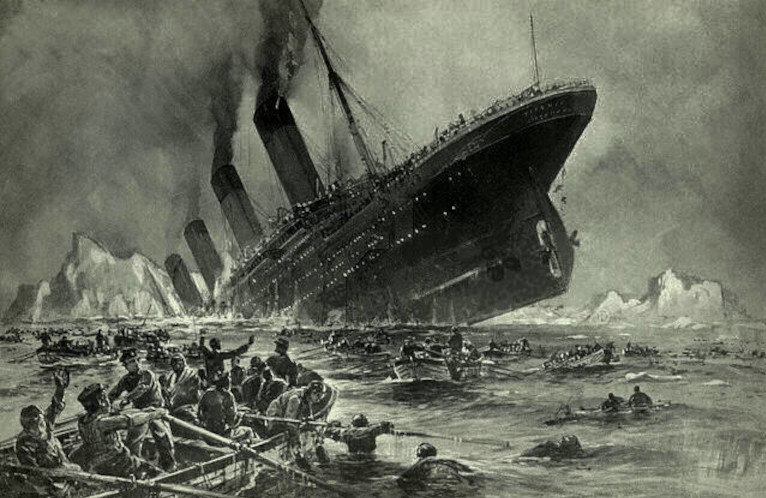
I’m more concerned with the course and speed of the Titanic (or why there even is a Titanic) than with the proper arrangement of deck chairs. Of course I would much prefer an orderly arrangement of deck chairs rather than a trip-hazard jumble: in the narrower fantasy that they also remain dry and well above sea level. As in Ishmael Chapter 12, my chief aim is not fairness and equity within the prison, but in dismantling the prison altogether—arguing that we oughtn’t be on the Titanic in the first place.
Being so far from the mainstream, how do I know that I’m far to the left of “left” and not far to the right of “right?” That’s pretty easy, because the left–right distribution can be crudely mapped onto preference for egalitarian arrangements vs. tolerance of hierarchy. My guiding principle is that humans evolved in small tight-knit groups of basically egalitarian people. These successful cultures tend to be very light on power structures and division of labor. In fact, many follow deliberate practices tuned to tamp down power concentration. In those cultures that recognize a leader, the leader does not exert power so much as make sacrifices for the team and offer valued opinions on appropriate actions.
The opposite of hierarchy is, in some sense, anarchy: lack of archy—where the “arch” root means “rule.” Anarchy has a bad rap for the legitimate reason that it’s a terrible, non-viable way to structure modernity. But I would say modernity is no way to structure ecologically-suitable living. Anarchy works exquisitely well in the community of life. It’s hard to exert power over people who can take care of themselves (including their own access to food).
It’s funny that the political left and right both argue endlessly and unproductively about rights (for corporations, humans, blastocysts), but I’m so far left that I see “rights” as fictional constructs of “the right” (which includes Marxists for me). Rights are not facts of the universe—thus the inevitable, unresolvable squabbling—but unfounded claims that we might wish to be true geared toward giving us things we want.
Part of the fantasy is that if we just adopt the correct political perspective, tune our laws, and dial in our systems, we’ll finally achieve the paradise we deserve—as the irrelevant, obsolete community of life cracks up and disintegrates. Ecological and biophysical considerations over appropriate timescales are typically wholly absent from such musings, instantly invalidating them as viable paths.
So, whether we’re talking about Karl Marx, Ayn Rand, Noam Chomsky, or Milton Friedman, they all look strikingly similar from my vantage in the hinterlands. All champion anthropocentric systems doomed to fail by ecological standards on biophysical grounds on the timescales that really count.
Comments
The astronomer and Marxist Antonie Pannekoek, writing in 1909 observed: ‘Natural resources are exploited as if reserves were infinite and inexhaustible. The harmful consequences of deforestation for agriculture and the destruction of useful animals and plants expose the finite character of available reserves and the failure of this type of economy. Roosevelt recognises this failure when he wants to call an international conference to review the state of still available natural resources and to take measures to stop them being wasted. Of course the plan itself is humbug. The state could do much to stop the pitiless extermination of rare species. But the capitalist state is in the end a poor representative of the good of humanity. It must halt in face of the essential interests of capital’.
Pannekoek, who died in 1960 just as humanity entered the space age, would later write: ‘It is time for mankind to ensure itself of material abundance by establishing a free, self-managed world-society of productive labor, thereby freeing its mental powers for perfecting its knowledge of nature and the universe’ (A History of Astronomy, 1951).
Exactly. It can be almost impossible to have a political conversation with anyone. What they get caught up in often feels so "less than" what is most important IMO. And yet to come off as dismissive or uninterested is rude. So boredom is how I feel much of the time. This has occurred to me recently when listening to Ezra Klein podcast about his book Abundance. The left is arguing about how to carry off a vision of a kind of liberal MAGA, where the future is an ecomodernist utopia. It is amusing they can't agree on even how, and they don't reflect on the topic of complexity and the diminishing returns problem starting them in the face, which is partly why they don't know how to do anything. Zero conversation is about the what to do. They seem to all agree that their liberal MAGA is a Green Manhattan with machines in the fly over states taking care of the harvests for the human supremacists. It's all very 1950s Jetson's vibe.
You speak my language, which, after too many years, is silent. In silence lies the answer(s). All the grasping and its attendant lying, paranoia, anger, rage and violence, resulting in bio-chemical madness. Certainly, OCD, PTSD, bi-polarity, the Autism spectrum, ADHD, are all curve balls meant to bend around this madness. The madness dislikes criticism, so it enables addictions. Now, addictions rule, are the norm, are viciously defended, hence more violence. The gut biome, photosynthesis, love, compassion and the soothing comfort of quantum entanglement are all I see as necessary, but yet just out of reach. There is a scene in Lord of the Rings where the Witch of the Woods is tempted by the power of the Ring. She tastes the edge, demurs, and retreats to the forest, knowing it is better to not meddle with stochastic energies.