

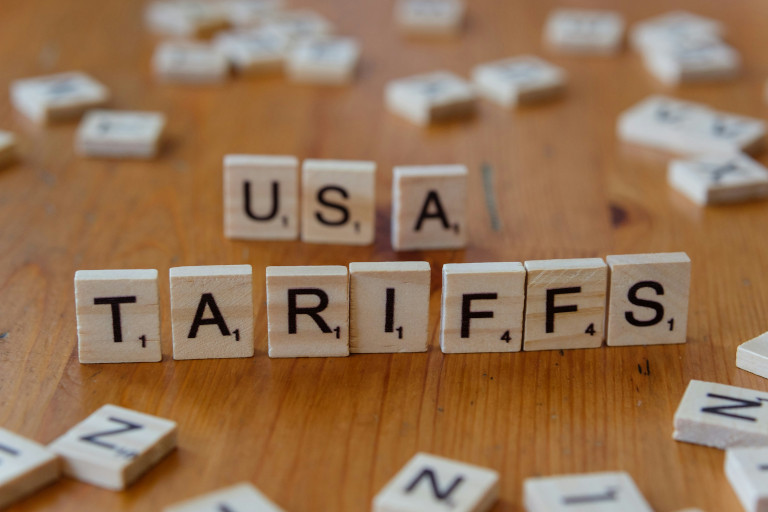
On so-called “Liberation Day,” the Trump administration announced its new wave of tariffs. The language was poignant. Liberation. It was a word meant to stir, to conjure up the dream of breaking free from foreign exploitation.
Dependence on global trade is indeed a trap. For decades, our deepening reliance on faraway markets and supply chains has left us unable to meet even our most basic needs – from food to jobs to medicine. We’ve become chronically dependent on the whims of global businesses, banks, and their distant, profit-hungry boards – institutions over which we have no control.
So there is a real need to move away from this dependence by diversifying our national economies. In fact, in an era of climate shocks and pandemics, it makes sense to decentralize the production of our basic needs as much as possible. And this would require the right to prioritize and protect our local, regional and national economies from global monopolies.
Oh protectionism, that old word. Thanks to Trump, it’s been taken down off the back shelf and dusted off for the first time in decades. Most mainstream commentators speak the word like vitriol, but common sense begs: what’s wrong with protecting your own economy?
The question is: protection from whom?
Trump believes the danger comes from other countries “ripping us off.” But that’s yesterday’s story. Today, multinational corporations hold more wealth and power than many nation-states – and they owe allegiance to no country. Investor-State Dispute Settlement (ISDS) clauses in trade treaties allow corporations to sue governments for trying to protect people or planet. From Thailand to Germany, governments have been sued for “lost profits” over everything from banning toxic mining to raising minimum wages. This paralyses national governments and makes a joke of democracy. It leaves no doubt about who calls the shots in the global economy.
Against this backdrop, tariffs offer no path to freedom. They are outdated, antagonistic gestures that pit countries against one another at a time when we should be uniting against our real common oppressor: corporate rule.
That said, it is possible that tariffs could help reduce the most absurd kinds of global trade. Take, for example, the fact that, every year since the covid pandemic, the US has imported about 1.5 million tons of beef – more than any other country. And guess what – it exported almost exactly the same amount. This trade-for-trade’s-sake squanders precious resources, drives up emissions, enforces toxic monocultural farming across vast areas, and contributes to the build-up of mountains of plastic. But emissions from global trade receive no mention in the COP climate negotiations.
So perhaps a silver lining might yet be eked out of the tariffs proposed. To make a real difference, however, they’d need to be part of a coordinated plan to rebuild healthy national, regional or local economies. And Trump’s tariffs are part of no such plan. In fact, quite to the contrary: the administration recently cut $1 billion in funding for two USDA programs designed to help local food purchasing – initiatives that were just getting on their feet, born as they were out of the supply-chain chaos of the COVID era. Meanwhile, Trump’s tax cuts continue to favor the global elites, and his plans to ramp up industrial extraction do not square with any attempt to protect and nurture local resources.
In exposing the limitations of tariffs, let’s not buy into the propaganda spouted by the mainstream corporate media, which continues with zealous assertions that global trade benefits us all. Even left-wing commentators have been largely unhelpful in exposing the truth about global trade: that it’s enriched global corporations at the expense of society; that it’s been an ecological disaster and an economic trap.
It’s also been an assault on people’s jobs and prosperity. In the Global South, millions of land-based people have been disenfranchised and uprooted to fuel sweatshop economies. In the North, workers have been laid off or demoted as jobs were shipped overseas. With the deregulation of trade and finance, the gap between rich and poor has widened to obscene proportions in almost every country, and even once-affluent middle-classes are plagued by economic instability and a cost-of-living crisis.
In this way, the economic tyranny of globalization is what made space for demagogues like Trump to come to power in the first place. The forces that elected him are largely borne of rising economic insecurity and discontent with the political process. And he is far from an isolated phenomenon. Confusion and fear, unaddressed by mainstream media and politics, has been capitalized on by the far-right worldwide.
So, yes, we need to condemn globalization loud and clear. And we need a cohesive strategy that moves us sensibly and sanely in the opposite direction.
The strategy would be two-fold:
-
Re-regulate multinational corporations. Rein in their impunity, revoke their special rights under trade law, and hold them accountable. This would be the first port of call for halting the corporate takeover of our democracies and protecting human rights and the environment.
-
Simultaneously rebuild resilient, regional economies. This means reinvesting in local infrastructure, supporting education and training for place-based employment, prioritizing research and development for smaller-scale production, clearing red tape for local businesses, and—most crucially—regenerating the real economy: soil, water, biodiversity, and the fabric of interdependent human communities.
In many areas of the world, from the USA to China, from India to Australia, people are already engaged in this work: they are forming local business alliances, starting local finance initiatives, exploring locally-based education and energy schemes, and, most centrally, building a genuinely regenerative local food movement. All of these efforts reweave the fabric of local interdependence and connection. And while they are already growing, policy change is really needed to help them multiply and flourish.
This two-pronged plan has a name: localization. And that would offer a real escape from the global trade trap – a scheme worthy of the word liberation.




Comments
Thanks for this thoughtful column. There are some deep ecology ironies to Trump lowering CO2 for a little while (definitely not what he intended), but the other harms, dozens if not hundreds of them, overwhelm any "good" he is doing. I'm especially angry about what you wrote above about how "the administration recently cut $1 billion in funding for two USDA programs designed to help local food purchasing – initiatives that were just getting on their feet, born as they were out of the supply-chain chaos of the COVID era. "
I made the mistake of mainly writing about how civilization would fail within a week in my book "When Trucks stop running: Energy and the future of Civilization" about road trucks, that deliver nearly all goods to nearly all businesses and homes. I should have talked about agricultural diesel vehicles such as tractors and combines that grow our fuel: food. The thing is, we automated farming so much that today what is needed are young folks learning to farm as in John Jeavons "biointensive" methods recommends in his classes and books. I suspect that if there is rationing to agriculture as a first priority, as the US Department of Energy 1980 oil rationing plan recommended ( https://energyskeptic.com/2013/1980-oil-rationing-plan/ ) the U.S. will double down on mechanization to feed people as long as possible and not start to train people for an agricultural way of life, eventually up to 80 to 90% of people.
All of these efforts reweave the fabric of local interdependence and connection.
Interdependence and connection may be good, but why can't we substitute "global" for "local" in the above sentence? Norberg-Hodge claims that it's because the global market has been taken over by powerful corporations, and I agree that this is bad, but what is to prevent powerful entities, perhaps including corporations or even warlords, from dominating local economies, too?
Interdependence and connection are the core of Ricardian "comparative advantage", a concept at the heart of all trade, including international trade. Treaties are intended to fairly regulate international trade and laws regulate intranational trade.
There is nothing magical about localization that automatically results in justice and equality. The nuclear family is about as local as it comes, but we all know that single family households can contain abusive members. What keeps all relationships fair and just, from the family to international trade, are rules and regulations, whether implicit or explicit.
I agree that relocalization is going to be inevitable as the energy needed to power the global market and modern trade disappears. Trump's tariffs might very well jump-start the process of deglobalization, but all of the problems with power relations and inequality will still remain. We condemn globalization not because it is global, but because it is not just. We need to keep in mind that justice is scale invariant.
Hey Joe, thanks so much for engaging. I'm Henry, one of the authors.
As you point out, localisation is no magic wand – no guarantee of justice. However, we do believe the shortening of distances between producer and consumer is a prerequisite for just economic relations, as well as for real accountability and sustainability.
The large scale and long distances in the global economy have created a structural blindness, which has allowed corporations to obfuscate the real-world effects of their actions for so long. A consumer in the supermarket has no sense of the deforestation and displacement of people for the palm oil in the biscuits or soap they buy. Even employees and CEOs in the corporation may be blissfully unaware of the true ecological and social costs of their business activities, buying into ideological fairytales of 'economic growth'.
On the contrary, a place-based business – even a national industry as opposed to a global one – can be held to account through democratic oversight. A really localised producer can be held to account even more directly – by the people they employ, by the consumers they sell to, by community they serve. Rules and regulations are of course important, but they are hopeless if there is no oversight/visibility.
The overall pattern is clear: the shorter the distances, the more transparency and accountability is made possible. The more globalised the industry, the harder it is to hold it to account.
The same is demonstrably true for government. Larger-scale levels of government (state, national and international) are more prone to co-optation by big money. It is no coincidence that most national governments are in the pockets of corporate donors and lobbies, while international organisations like the IMF, World Bank and WTO and even the COP climate negotiations are the all-out champions of corporate agendas. Smaller countries like Sweden and New Zealand (while still ultimately fallible and tied to corporate globalism) have had a better run at democracy compared to a larger nation like the USA. Municipal governments across the globe, disempowered though they are, have sometimes been able to take bold, progressive action on social and ecological issues. This is because they are generally more in touch with, and responsive to, grassroots pressure.
Against this backdrop, it is hard to see how a just form of globalism is anything other than a pipe dream. We do condemn globalisation because it is global — because justice and scale are inextricably related. Localisation is not a silver bullet, but it is a practical path towards justice.