

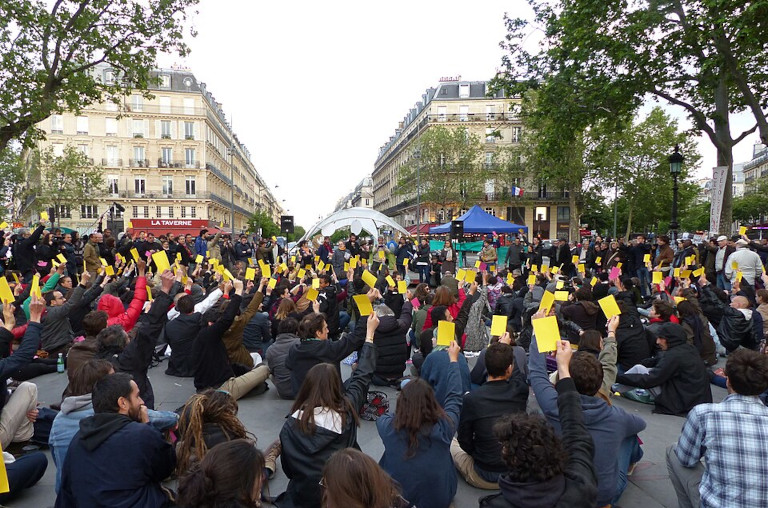
The organization “The General Strike” aspires to mobilize approximately 11 million people committed to coordinating a massive work stoppage. The magic number of 11 million equals 3.5 percent of the US population – a figure that organizers argue will be large enough to transform the US power structure and give workers the agency to shape the national destiny with heretofore unprecedented scope. But what would the strike stand for? There is no set of demands, no concrete goal elucidated on “The General Strike” website. The values of “decentralization, dissent and diversity” are listed along with the rather abstract hope to “dismantle the master’s house.” Is there a way to offer a concrete means to dismantle the master’s house, to name the actual tool of deconstruction?
The first thought that comes to mind is that a general strike would be aimed at Trump – either demanding that he be removed or forced to observe legal and constitutional constraints. It should be obvious, however, that no legal guardrails prevented Trump from seizing complete control of the government in the first place. US political institutions have allowed him and his thugs to eagerly chip away at a welter of legal protections. Trump has carried out illegal arrests and deportations and there isn’t a reasonable person among us who can’t imagine themselves or their neighbors being taken into custody and locked in detention with no due process, no habeas corpus, no access to legal services, and only the predatory intentions of the Trump system to decide their fate. Opposing Trump is a worthy thing to do, but removing him would do nothing to dismantle the master’s house. The idea that Trump is a tumor on an otherwise healthy organism is obviously nonsensical. Trump is the ultimate Darwinian product of the primordial political soup of American politics.
We might assume that only so called undocumented immigrants will be Trump’s target, but once people succumb to the notion that limited persecution ought to bring a sigh of relief the gig is up. Fascism has been notoriously wide ranging and easily provoked, targeting, in its various nationalist regimes across recent history, journalists, Catholics, Protestants, Jews, Muslims, Socialists, intellectuals, sexual minorities, immigrants, trade unionists, various ethnicities, alcoholics, the mentally ill, the handicapped, the unemployed and the incarcerated. The wholesale protection of all victims of fascist scapegoating ought to be central to the organization of future strikes, boycotts and protests but a piecemeal assemblage of grievances on behalf of each targeted group does not truly address the scope of our national distress. The overarching, existential anxiety of our times revolves around power, and the disenfranchised status of ordinary people. Any movement that fails to confront the nexus between so called representative democracy and inequity is sure to fail.
There have been two broad categories of political resistance during my lifetime – those with specific, clear goals and narrative consistency, and those that have been decentralized, amorphous, spontaneous and short lived. The civil rights movement and the anti-Vietnam War movement belong to the former, the occupy movement and the George Floyd protests belong to the latter. The civil rights movement sought to secure voting rights, integration and institutional protections against racist violence, while the anti-Vietnam War movement simply protested colonial military intervention and atrocities in Southeast Asia. The “Occupy” and George Floyd actions featured “bottom up” passion, huge numbers in the street, but both lacked a sustainable and clear vision. This begs the question – can a political movement have both a unifying aspiration and decentralized, grass roots passion? If social protest is the means to oppose Trump’s fascism, how can such a movement connect to larger themes? Any resistance premised on the backward aspiration to reinstall the Democratic Party to its former stature will achieve absolutely nothing. The nostalgia for old school neocons like Reagan or the Bush family will offend most potential activists.
In some vague and uncertain way, most anti-Trump protesters have the idea that ordinary people ought to guide political policy, but the term “direct democracy” has been so unfailingly suppressed in public consciousness (particularly in the US) that the vast majority of us have never even heard of it. We know that our system is rotten, corrupt and despised, but we collectively share a fog of ignorance about how to replace it. Here is George Monbiot on the issue of direct democracy:
“An election is a device for maximising conflict and minimising democracy. Parties gain ground by sowing division and anger, often around trivial issues that play to their advantage. At the same time, as the big players seek to appease commercial lobbies and the billionaire press, they converge disastrously on far more important issues, such as austerity, privatised public services, massive inequality of wealth and the unfolding genocide in Gaza. Many of those who seek election manipulate, distract and lie.”
Two strains of toxic, destructive corruption have been baked into electoral/representative “democracy” – the certainty that the vast majority of elected officials will either come from or represent the interests of the privileged class, and the understanding that seekers of elective positions are disproportionately comprised of individuals with narcissistic, anti-social tendencies. The former can be easily confirmed – some 50% of US congressional members hold Ivy League diplomas – while the latter is the subject matter for a growing body of academic research.
Several years before Trump emerged as a political force, Harvard psychologist, Martha Stout, offered this warning:
“Yes, politicians are more likely than people in the general population to be sociopaths. I think you would find no expert in the field of sociopathy/psychopathy/
antisocial personality disorder who would dispute this… That a small minority of human beings literally have no conscience was and is a bitter pill for our society to swallow — but it does explain a great many things, shamelessly deceitful political behavior being one.”
The reason that politics exerts such magnetic force upon sociopaths remains speculative, but clearly few fields offer ambitious, self-obsessed seekers so much attention, power, wealth and admiration as politics – a field making relatively few demands upon its luminaries. Politics requires little self-discipline and only modest talent. Those burdened with monstrous egos, but lacking the wherewithal to be a concert pianist or an NBA point guard have a platform for public adulation generally reserved for those blessed with insane gifts. The combination of ambition and mediocrity creates a hell storm – a petri dish to nourish “the banality of evil.”
We now confront apocalyptic climate conditions in which fate rests in the hands of Ted Cruz, Marco Rubio, Chuck Schumer and their appointees. We are locked in an Orwellian loop of absurdity in which those tasked with the life or death struggle to lower greenhouse gasses receive campaign donations from Chevron. An utter lack of principle is a virtual requirement for high office, and as long as we elect leaders via the ballot, sociopaths will eagerly trade their humanity for power.
Monbiot makes the argument that direct democracy would transfer the locus of power and influence from oligarchs and corporatists to the masses, but he does not address the narrative issues. It has been possible to mobilize public passion against war, police violence, climate, and even against the amorphous transgressions of Wall Street, but how do masses of people organize and take action on behalf of an abstraction? Can people be outraged and inspired to demand that democracy be redefined and the structures of government be dismantled and recreated? Can people gather in the streets with the understanding that representative democracy is the cause of war, police violence, environmental collapse and poverty? Indeed, one ought to see representative democracy as a front for capitalism. The issue confronting us is overwhelmingly one of narrative inadequacy. People are outraged by contingencies, but largely unaware of the root causes. We gather in enormous numbers to protest police brutality, but never offer a whimper of distress about the political structures that enable police violence.
Direct democracy has never been a rallying cry for mass activism, nor has it had significant support among leftists. This may be changing according to South African Marxist sociologist, Michelle Williams, who has written that direct democracy has become a central focus among some factions within Marxism. Williams writes:
“While democracy is a contested concept that often incorporates very different notions of social change and control, with various actors and processes, twentieth century liberals and Marxists tended to focus on representative and vanguard democracy respectively, largely ignoring the importance of direct and participatory democracy.2 Bertrand Russell (1946: 14) pithily captured the central distinction: the Western understanding of democracy ‘is that it consists in the rule of the majority; the Russian view is that it consists in the interests of the majority’. Neither tradition emphasised government by the people. The bifurcation of democracy into representative democracy versus vanguard democracy severely limited the debate on democracy in the twentieth century. In the twenty-first century, political movements are attempting to transcend this dichotomous view of democracy and have placed direct and participatory democracy at the centre of alternative, emancipatory visions of the future through meaningful deliberation and participation in political and economic life by ordinary citizens.”
There are many theories and models of direct democracy, but the unifying principle animating it requires that common, ordinary people, rather than elected proxies, make all important decisions. This might involve public referendums to decide whether or not to legalize abortion, or it might require that ordinary citizens, selected by lottery, form citizens’ assemblies authorized to make important decisions (for example) on medical care, low income housing and military budgeting. A deliberative body chosen by lottery (sortition) would manifest the inherent diversity of the public – people living in tent cities, members of sexual minorities, people saddled with medical debt, factory laborers, teachers, artists, musicians and palm readers would all have the same access to the deliberative process as a billionaire’s son with a Harvard law degree. It goes without saying that tokenism, identity politics and racism would be washed away within systems of direct democracy. The media, relieved of the mandate to brainwash voters, might be free to pursue journalistic principles of honesty. The Ivy League, no longer tasked with turning overly privileged prep school grads into political leaders would be free to…uh…educate students. The serendipitous ripples of direct democracy would be unimaginably liberating.
While direct democracy may not have the narrative ballast currently needed to inspire passionate action in the street, it is not wholly without public support. Extinction Rebellion has demanded that climate mitigation policy be delegated to a “citizens’ assembly” chosen via sortition. The Sortition Foundation of the UK has proposed that The House of Lords be replaced with a House of Citizens chosen by random selection. George Monbiot references Belgium author, David Van Reybrouck’s suggestion that both The House of Lords and the US senate (a relic of slavery, giving disproportionate power to reactionary, rural communities) be replaced by “people’s assemblies.”
Marxist economist, Richard Wolff – reflecting Michelle William’s assertion that direct democracy has become a hot topic in Marxism’s renewal – argues that the relationship between a communist factory employer and a factory worker is, like the capitalist/worker dichotomy, inherently undemocratic:
“It follows that socialists’ self-criticism—that actually existing socialist systems fell short of their standard of real democracy—may be linked crucially to those systems’ retention of the employer-employee relationship at their economic core.”
Wolff proposes that factories be organized around principles of classlessness – that workers themselves should make all the decisions regarding working conditions and production. The model of the “worker’s co-op,” as Wolff envisions it, takes two classes and compresses it into one. Wolff has argued that real democracy does not exist if the work place is sequestered as an exceptional space run by authoritarian values.
This brings me full circle to the potential power of “The General Strike.” If 11 million people are to mobilize and make demands, what demand truly addresses the issue of fascism, war, inequality, poverty, medical neglect, and lack of housing. A revolutionary movement has to have a revolutionary goal – the overthrow of the corrupt, rotten structures of end stage capitalism and the replacement of decayed structures with new, responsive institutions. The organizers of The General Strike boldly proclaim the intention to “dismantle the master’s house”, but what will they replace it with?
If direct democracy, sortition and people’s deliberative assemblies do not seem to be sexy enough to inspire mass protest, then it becomes the task of writers on the left to give these concepts a narrative makeover. I recall marching at anti-war rallies in the 1960’s and chanting “power to the people.” Little did I know in my youth that political ideas with roots in ancient Athens had addressed that chant with specific, philosophical arguments.

The following excerpts are from History for Tomorrow by Roman Krznaric:
"Civilisations are not simply driven by technological innovation: some of humanity’s greatest advances have been just as much in the realm of social innovation. Our forebears pioneered multiple ways of organising to survive crises, tackle injustices and live peacefully together. They invented social movements."
——————–
"So let’s not simply look to technologies to save us, or to great leaders or powerful gods. Let us look to each other, to people’s ingenious ability to work together to solve problems, inspired by our collective values."
————————
"If our ancestors learned to do things differently in the past, then maybe we can too."
————————-
"History enables us to break out of the straitjacket of the present, so we can envision a plurality of futures."
———————
"At a personal level, history can do much more than help us realise that there is hope for transformative change: it can also spur us to become one of the changemakers ourselves."
———————
"From joining a protest movement or setting up a cooperative enterprise to taking part in a citizens’ assembly, history reminds us that we are part of great traditions of active citizenship that stretch back far into the past."
————————–
"There is good reason to fear that we will not meet the challenges of our age: we may respond to crises far too late, or succumb to the risks of runaway technologies. But with history as a guide, there are just as strong grounds for believing that we can create a civilisation that bends rather than breaks as we confront the turbulence of the twenty-first century. It is time to draw on history for tomorrow, and turn radical hope into action."
This is so up-front. I have been writing and speaking for some years on this topic, including just yesterday on Substack. Your comments are all germane. How do we get from toxic delusion to some form of raw but quasi-intelligent and pertinent decision making? The comments below are a big start, and all have potency. Democracy literally means 'to vote.' Have some say on something already per-determined by 'oops' non-direct representation. Zero-sum at its worst.
Right now we have almost no avenue to move from the streets or fields to the politbureau – the Constitution limits that to the non-working status quo of failure and almost certain demise into extinction. We must follow the rules as stated, many say, because those rules rule out direct representation/democracy(all must vote for their own vision of societal needs).
In the weeds is where this challenge is lost. Too many personal distortions of what objective reality might look like if human society is to become sustainable and ecologically wise. Right now our population is not only under-educated and mis-educated, but also stressed out, dumbed down, malnourished, drugged up and manipulated via propaganda.
Jeff Krasno's new book Good Stress delineates what it might take to break through the fog of addictive self-interest. The situation we face due to the nihilist cabal putting the squeeze on is certainly one example of how challenges that are life-affirming can clear the mind. But this article shows that without some pattern, a cornerstone of ecology, the ability to bring together top-down and bottom-up necessities literally crashes and burns.
I attended the second rally on 4/19. It was so much more cohesive, energetic and determined than the first. The signage is one method of direct expression from an individual about personal needs. You would be amazed at the amount of co-generation of like-mindedness in those thoughts. I was, and I am not a cheerleader of that type of quasi-autonomy.
We must really amp up this discussion, because I see it as the only alternative to either total fascistic repression or open warfare between the population and its so-called leadership, which, win or lose, will not create a viable pattern for continuance.
"the unifying principle is that common, ordinary people, make all important decisions." … that means Direct Representation (so please drop the word "democracy", because that's where the narative gets lost).
The fastest way to get to Direct Representation is to use it in everyday life. At home, at work, in the sports team, at school…. Once normalised in time, out of habit, it will automatically diffuse its way into all the higher layers of our social fabric.
I guess that Systemic Consensus** can be this vehicle. It's extremely intuitive*, easy to understand and use. It's very scalable and already digital** so the step to full direct political representation – using personal contextually informed, manual over-rulable, AI avatars – isn't far off … if we want it. I know I do:)
* watch Systemic Consensus being used at minute 12:00 > https://www.youtube.com/watch?v=dsO-b0_r-5Y ** https://sk-prinzip.eu/
*** https://acceptify.at/de/start
" "the unifying principle is that common, ordinary people, make all important decisions." … that means Direct Representation (so please drop the word "democracy", because that's where the narative gets lost)."
We can get lost in semantics, but I am not certain that a person picked via sortition to be part of a deliberative body is "representing" a constituency. The claim of representative authority is exclusively used by candidates for elective office (usually in a flagrantly mendacious way) while a person chosen by lottery essentially represents their own values, style and positions. If I am chosen via sortition I may not even want to serve – just as jurors may show up for duty to avoid fines and not to "represent" the jury system. It is only in aggregate that a collection of semi-willing participants manifests the whole citizenry. A town council (lets pick 9 people) in a city of 30K, chosen at random, is far more likely to embody an accurate picture of local perspectives than 9 people seeking elective office via raising money from local business interests. But these people represent nothing more than the hope that chance selection will accurately reproduce the latent aspirations of the town as a whole.
I enjoyed the talk you linked, but will need more info. I am usually suspicious about schemes to make businesses responsive to the common good. It would seem that the common good would be better served by worker co-op models (as advocated by Richard Wolff) in which workers make all decisions together rather than deferring to the boss.
BTW – I am Phil Wilson and pooshoodog somehow became my DISQUS handle. Pooshoo was the name of a beloved, departed, family yellow lab.
Direct representation means everybody represents themselves, no in-betweens needed, no elections, no sortion, etc.
Also in co-op models collective choices (goverance) need to be made somehow. Systemic Consensus is simply a practical tool to get this done. It’s more effective and far less divisive than majority rule. (builds far more consensus)
In larger groups, it’s more practical than Sociocracy, a goverance model I’ve been using the last 25 years in various organisations. Read SC’s history (with Google auto-translate ) > https://sk-prinzip.eu/sk-prinzip/sk-historie/ as that gives a good insight into why they developed it.
Places with ballot initiative rights: use them to advance democracy, and democratize the processes of democracy. Ultimately better working examples have to demonstrate what is possible before radical constitutional change is likely at the US federal level, but we are quickly running out of time.
One possibility/jumping off point:
https://democracynyc.org