

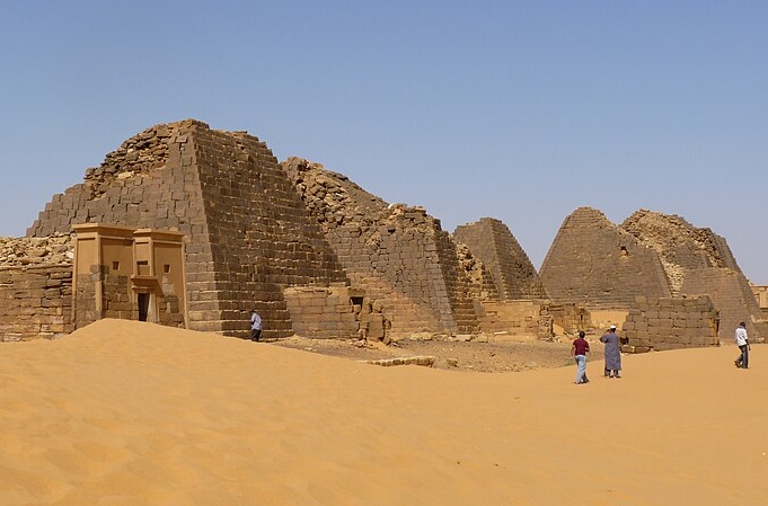
The sensible Swedes like planning ahead. This time it’s storage for nuclear waste from its own nuclear industry—storage that is supposed to last 100,000 years. Nuclear power currently provides 40 percent of Sweden’s electricity from six operating reactors. The Swedes expect to fill the storage site—”60 km of tunnels buried 500 metres down in 1.9 billion year old bedrock”—sometime by 2080 at which time it will be closed.
For understanding whether the target of 100,000 years of successful storage is plausible, I suggest a trip back 100,000 years to understand what surprises might be in store over such an interval. One hundred thousand years ago the Bronze Age, the age when humans first started to refine and work with metal, was still 97,000 years in the future.
It might seem that not much happened in those 97,000 years, but actually a lot that could challenge such storage schemes did. For example, somewhere around 71,000 to 74,000 years ago Mount Toba, located in modern-day Indonesia, erupted in a supervolcano thought to be the largest in human history. The eruption was two orders of magnitude (100X) larger than another famous Indonesian volcanic eruption, Mount Tambora, which caused what is now referred to as “the year without a summer” in 1816.
The Mount Toba eruption created an instant ice age and so devastated plant life that one study suggests as few as 40 breeding pairs of humans survived across the Earth. Other estimates suggest 1,000 breeding pairs. Even if 5,000 to 10,000 survived, as some researchers suggest, modern humans almost disappeared.
Of course, another Mount Toba might just solve the problem of keeping humans away from Swedish nuclear waste because there will be so few people left who could end up drinking radioactive water or touching radioactive soil that we needn’t worry. But a lesser disaster might only, say, halve the human presence on Earth while destroying the kind of complex technology and crucial political structure that make it possible to monitor such waste sites.
Forty thousand years ago Neanderthals, a competing species of humans, went extinct. We think of Neanderthals as being less intelligent than we Homo sapiens who survived. But their full name, Homo sapiens neanderthalensis, and what we know about them suggests that that may not have been so. In any case, one theory is that climate change contributed to their demise. We Homo sapiens who remain seem destined for a similar climate challenge that could over time at the very least degrade the stability of human society to such an extent that looking after nuclear wastes would be very low on the agenda. Again, it is not a wipeout that creates a problem, but rather growing paralysis and disorder.
What we call civilization, that is, human settlement in cities, has only been around about 10,000 years. That’s hardly an endorsement for continuity over the next 100,000. Maybe the Swedes believe that the way they are burying their nuclear waste will make the coming and going of human civilizations over the next 100,000 years irrelevant. But, how could they possibly know that? After all, one Swedish environmental group is going to court to challenge the plan because “research from Sweden’s Royal Institute of Technology showed the copper capsules [used to contain the waste] could corrode and leak radioactive elements into the ground water.”
Okay, maybe you’re thinking that surely in the future our technological prowess will be always ever greater and so containing these wastes will ultimately be a trivial problem in retrospect. There are so many answers to why that will almost certainly NOT be the case. The simplest one is that technology relies on energy and our inability to get beyond fossil fuels which are finite to something even more dense and versatile doesn’t bode well for an advanced technological future.
A second argument comes from the past, but it is so very consistent in its message. Most of the civilizations we now know about no longer exist today. For any number of reasons—demographic decline, climate change, plague, political discord, loss of resources—they just petered out or disappeared.
I understand that now that we humans have produced this waste, we ought to figure out how to store it safely for the sake of whatever life, both human and nonhuman, comes after us. One solution would be to reprocess it to get the usable radioactive products from the waste and use them up as much as possible. That reduces but does not eliminate waste. And, reprocessing is expensive and dangerous and essentially a doubling down on an advanced technological solution.
Of course, another problem is that reprocessing is great for extracting plutonium that can be used in nuclear weapons—which could lead to another kind of disaster. Beyond this, worldwide the amount of waste continues to increase and there are plans to build new nuclear reactors without a solution to the waste problem having been realized on any scale necessary to take care of wastes from all the countries of the world NOT called Sweden. That’s why burying what we have in the ground seems like a cheap and viable solution in comparison to reprocessing—or the totally crazy idea of shooting such waste into space or into the Sun.
I just wonder how knowledge of such waste sites will be preserved for 100,000 years. I wonder whether we humans can build something that will last 100,000 years given our record and the dangerous exigencies of life on Earth. And, I wonder if we were wise to create something in the first place that requires 100,000 years of care, given how heedless we as a species are to hazards of our own making that may destroy our current civilization much, much sooner than a thousand centuries from now.

Comments
Good post Kurt. It is very hard to get our minds around the time scales involved. I like your Bronze age example.
I suggest everyone look back at some "English" writing from only 1000 years ago. Can you read it? But the British Isle's were hardly the center of human culture, 1000 years ago you say? How can we expect it was well preserved? Fair point.
Consider this example:
Here is a link to an Egyptian Tomb Warning Stone.
https://blog.nms.ac.uk/2017/06/23/ancient-egyptian-tomb-warnings-curses-and-ghosts/
I encourage everyone to go take a look at it. Try to read it. Remember that Egypt was the super power of it's day. It changed, fractured apart and rejoined multiple times. But the rituals, language and iconography of that civilization remained largely intact for at least 3000 years. The Roman empire only lasted 800 years. Yet, can you read that inscription? Or even Latin. How many people are left who can read the language of the Roman Empire? How many will be left in 1000 years?
Limits to Growth made clear that Civilizations can end themselves via pollution. The longer the half life of the pollution, the easier it is to build up to civilization destroying levels. The long half life of nuclear waste is one reason why nuclear power is so dangerous. Nuclear power is like selling your immortal soul for power in the here and now. You get a nice burst of energy now, but you must pay interest on that energy for 100,000 years. Not wise.
I fear that without making wiser choices, that all the legacy humanity will leave behind in 100,000 years is a radioactive sedimentary layer in the geology and a mass extinction in the fossil record. That saddens my heart.
I really enjoyed this article. It underlines the incomprehensibility of such timescales in relation to human 'civilisation'. Also agree that creating such nuclear waste in the first place may not be the wisest decision humanity ever made. However:
a) the article makes wonderfully clear the unreliability of both human society and the planet's changing surface environment — meaning that the Swede's decision to bury the waste deep underground for 100,000 years is a far safer bet than just leaving it in surface storage 'pyramids' for the next 100 millennia, because
b) even if we never use nuclear power again the world already has 250,000 tonnes of this waste accumulated since the dawn of the nuclear age 80 years ago — it's not going to disappear just because we don't like it, and we need to deal with the waste we've inherited from our grandparents' generation.
This article seems to articulate exactly why the Swedes (and every other country with nuclear power, eg Finland, Switzerland, France, Canada, USA, Russia, China, UK, Germany, Japan, India, Korea, Saudi Arabia etc etc etc) are "geologically disposing" of their waste — its horrible stuff, in an ideal world we should not have, but leaving it on the surface while it decays over 100,000 years is not a solution, for all the reasons set out by Kurt!
Feel free to oppose future use of nuclear power, so we do not add to the stockpile of nuclear waste. But do not delude ourselves that the waste we already have can be managed for 100,000 years — for all the reasons set out in the article — unless we bury deep beneath the earth, away from accidental human intrusion and surface calamaties, in rock that has been stable for billions of years, and will remain stable regardless of what humans and nature does on the surface for the next 100,000 years.
The place where they built the storage was covered by 3 km of ice during the ice age….
Did the area suffer isostatic depression and rebound during and after the ice age? If it did (which is most likely) what does that say about 'stable'?
The only thing that comes to mind in terms of human safety and security is that this project needs to be juxtaposed against prognoses that resource scientists around the world are honestly debating: an almost certain collapse of our civilization, most like within the coming 100 years. Not that that scenario necessarily means complete obliteration, but it is a salient and sobering marker of relative time scale. In that respect the Swedes seem to be going for vast overkill, if their principal purpose is to protect people.
That said, must say Scandinavians do non-sustainability much more tidily than does the rest of the world, which is more into open ransacking with nary a thought for next generations.
Despite all the disinformation on the net, I worked on the beginning stages of the largest nuclear waste disposal site ever built. The WIPP facility in New Mexico USA has been in operation since 1999 following more than 3 decades of almost constant conflict and litigation. It is designed to handle Transuranic nuclear waste, but many efforts to convert it to hi-level waste are in the mix. Since its opening it has had at least two major accidents, one closing the site for several years and requiring hundreds of millions of dollars in repairs. I descended a half mile down into the salt beds of the Permian basin to observe how the waste would be stored. It was initiated as a pilot project, but my colleagues told me, in confidence, that the only intent was permanent disposal. The site was authorized to last as a storage facility for 10k years, but the half life of certain transuranic daughters requires that the waste cannot be exposed for upwards of 250k years. The waste is packaged in drums or barrels, then moved into 'drifts' (chambers mined in the salt), which slowly close around it. The ancient salts have always moved around, under immense gravitational pressures from above, and when drifts are carved insid ethese salts, it releases small regions of pressure. Both machine and waste fires have occurred, and unknown quantities of radiation have escaped the ventilation systems into the surrounding environment. As alpha emitters, Pu wastes are the deadliest toxins in the world, but cannot do damage to biologic tissue unless they enter soft tissue and lodge there, creating potential cancers and/or mutations of DNA/RNA. Anyone who studies both transuranics and hi-level beta and gamma wastes knows that the tremendous heat generated by hi-levels is anathema to stable, long-term storage, all other potential problems being ignored. Hot wastes are terrifying. I have been in the company of health physicists after they had to enter hot waste sites that were leaking, and they were absolutely terrified for their lives. The salt beds are already very hot, at least 100 degrees F, and there is much ancient water inside the salt deposits, and it moves around via various geologic energies. I did QA/QC, wrote weekly reports to state, federal and corporate parties, as well as compiled a complete history of nuclear waste management up to the time I left, 15 years before it opened. Nothing in the true reality of nuclear material has changed since Madame Curie first discovered its radio-nuclear disintegration. Earth geology is perhaps the most entropic phenomena known. Nothing is for certain when human radioactive waste mixes with entropic physics in the mantle of Earth. Much propaganda exists hourly surrounding the use and handling of nuclear materials. Its alleged safety and efficiency are massively overblown, not via ignorance, but rather capitalist and military ambitions that have always disregarded the necessary mitigation, in real time, of playing with nuclear fire. There are two maxims in waste management – dilute and disperse, or condense and contain. Out of sight is out of mind can work with both methods, but radioactivity is silent, invisible and, quite obviously, so deadly that humans should never have opened that lid on Pandora's Box. Entropy rules, uncertainty abounds, and chaos is the ultimate arbiter, as powerful as any mythical god that could be imagined. Technology is not a savior of mankind, it is the Grim Reaper.
Heat output decreases exponentially. By 100 years, spent fuel heat output would be down to less than 1 watt per kilogram.
With spent fuel radioisotopes there are more possibilities, such as transmutation, utilization, and consumption in fast reactors.
We live on a radioactive planet, and every human that ever lived was radioactive from birth to death, and beyond. All we need to do is avoid exposure to high levels of ionizing radiation. Containment and shielding has been working well for that–which is how spent fuel handling and storage has achieved such an impressive safety record.
Respectfully, to your points – heat dissipation, yes, if there is a stoppage of inflow. But during the 100 years, in salt, the natural movement of salts will have been greatly exaggerated, with no in situ methods to monitor what happens to the isotopes in that entropic period. The three solutions you mention of spent-fuel isotopes are all part of the condense/contain strategy, just recycling/reusing the tier one waste. Eventually, there will be unusable waste left, IF what you say actually occurs. The very recent Swiss model has yet to be tested to scale, and has its own very expensive price tag. As to the radioactive planet, sure, but unplanned or unscheduled releases that are quantum levels higher than background already occur, and I would be crazy to speculate that every potential storage method will remain secure for 10k years. Technology has an end point in many areas right now. To suggest humans will ever control their technology is the work of science fiction.
I didn't have in mind depositing the radioisotopes directly into the salt. I was thinking about something like a Deep Isolation sequester, such that the isotopes are locked in glass, ceramic, or synroc, contained in emplacement cannisters, packed in clay, inside well casing. Even if the heat output could theoretically increase the salt flow characteristics during the first hundred years, the salt would need to have somewhere to flow to. We know that salt is plastic and deformable at depth, but that hasn't resulted in the salt migrating out of the salt formations in the Permian basin, and the salt is still holding water from over 250 million years ago at the lowest levels. There's nothing to indicate that mildly heating the salt thousands of feet deep will give it a way to extract the isotopes from inside the casing and cannisters and carry them to the surface, especially in the few hundred years it would take for the heat output to drop to trivial levels. But even if there is a potential way that could be a problem, we can just sink the boreholes into other kinds of rock.
And fissioning, say, plutonium does not concentrate, compact, or contain it. It consumes it and converts it into fission products. Using neutrons to transmute technetium 99 into ruthenium 100 likewise does not concentrate, compact or contain it. You can shrink the overall waste volume by removing the usable industrial isotopes, but that isn't a condensing operation so much as it is an extraction operation. And even if there is some waste left after we've extracted all the energy and isotopes of value from today's spent fuel, the volume of waste will be greatly reduced, and most importantly, we will have eliminated the minor actinides (approx. 1% of spent fuel) which represent nearly all of the radiohazard in spent fuel after 1000 years. That tremendously shortens the hazard time.
As for exposure to radiation that is much higher than background levels, our dominant manmade source for that is medical procedures. And if you tally all the fugitive radioisotopes that got out of nuclear power plants, more than 99.99% of those came out due to core meltdown accidents. If we switch to reactors which cannot have core meltdowns, the aggregate radiation load to the public would be a fraction of just the variation seen in natural radiation, and would be dwarfed by medical radiation.
Thanks for that. I see your technological hope, and I do not insult it. But having been in the mix in the beginning, and having witnessed nothing salient among the decision makers, (NOT scientists or ethicists), I have, after 76 years of existence, zero confidence that any potential tech solutions will ever quell the myriad of selfish uses and abuses of the insane class of oligarchs and their monitoring sycophants. Most of our problems are not logical, but emotional, and there is no scientific remedy for these. I appreciate your intelligent and informative response. Strength and honor.
On the question of how we would identify and warn people away from nuclear waste sites for 100,000 years–when I was researching my last (unpublished) novel, I wanted to know what would last 50.000 years, which was then my idea for how long after humanity's demise the aliens would show up. I came upon a discussion, a project, to figure out how to identify such sites in ways that would be understood by people thousands of years from now. They concluded it really wasn't possible. Especially given that very possibly humanity would have lost technological and scientific expertise, and the danger–radioactivity–is invisible, inaudible and has no smell..
After 50,000 years, nearly all the radiotoxicity will be from alpha decay. So the main challenge would be how to communicate to people that they should not strip off the zirconium jacketing and eat the yummy-looking metals inside.
Yes, it would be like trying to warn them they would be haunted by invisible "curses". Even if they could read the warning, they would likely write it off as superstition and go get all the lovely copper and other purified metals in the disposal site. At least until the radioactivity starting killing them…
I think the best solution for disposing of our existing supply of "spent" fuel is to consume it whole in molten salt fast reactors. Several teams are working on developing those now, and even if it takes them 20 years to get them ready for deployment, that's nothing compared to a hundred-thousand-year timescale.
But even if we decide we would prefer to bury the spent fuel, the volume could be reduced greatly by removing just the uranium, which makes up around 95% of spent fuel–no need to separate out any plutonium. We could also extract those fission products which are not radioactive after about ten years. The remaining fission products and actinides would be about 2% of the original mass. That remainder could be vitrified into synthetic rock. If we mold that rock into cylinders to fit in Deep Isolation canisters, we could use existing drilling technology to put those canisters deep into the lowest parts of Permian-massive salt formations. Salt at that depth is plastic and flows slowly to seal any fractures or fissures, and the lowest levels still contain inclusions of water from Permian seas from more than 250 million years ago. So that would be a small amount of isotopes frozen into syn-rock, sealed inside canisters, surrounded by clay, inside well casings, thousands of feet deep, at the bottom of formations which could easily remain water-impermeable for another hundred million years. And it would even be fairly cheap to do that.
This makes a lot of sense–but only if what you propose to do to reduce the volume so much is itself safe.
If you mean safe in the sense of having a low risk of accidental criticality, there are safe ways to do it. If you mean safe in the sense of proliferation hazard, Russia, China, and others already have plutonium separation technology, and nobody is going to be able to get weapons-grade plutonium out of spent fuel anyway, so the risk there is pretty minimal as well. But it would be an industrial process involving radiation, high temperatures, electricity, and other hazards, so there would have to be some workplace safety standards. But we know how to do those. That's the reason spent fuel has a cumulative death toll of zero so far, even though we've been handling it when its radiation is at its most intense, fresh out of the reactor. (By 500 years, it would be 40,000 times less radioactive.)
The main obstacle to extracting just the uranium and then throwing the rest away is that there is no profit case for doing that, so it would have to be done by government mandate and appropriation. Or we could let a company like Curio LV do it for free, because they want to mine the fission products for profitable isotopes. But their plan is not to throw away the long-term actinides like plutonium and neptunium, but to incorporate them into fuel for molten salt fast reactors. I think that's a better solution than putting them in the ground, but for people who are keen on putting them in the ground, they should know that isn't Curio's plan.