

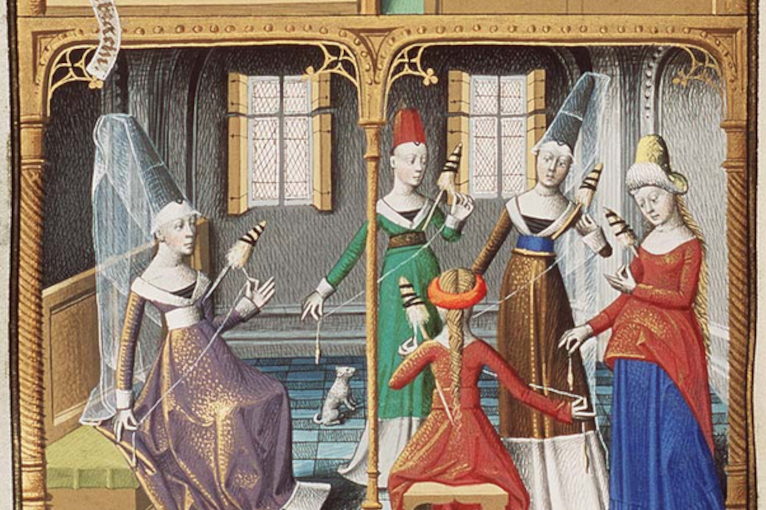
Today is Distaff Day, the day of resumption of women’s work. Those who remember this date at all — pretty much just me and sometimes the Old Farmer’s Almanac folks — have a choice of observing it on 7 January, the day after Epiphany, or on the first Tuesday after Epiphany. My grandmother was in the latter camp, claiming that it was Distaff Tuesday and did not happen until the first Tuesday after Epiphany. The Almanac folks have recognized a Saturday Distaff Day, but I like to hold off until the work week. Not that women’s work has a recognizable work week.
But this year, the day after Epiphany is a Tuesday. So it’s time for women to get back to work. Not men, though. Plough Monday, the day of resumption of men’s work, always follows on the Monday after Epiphany. In years when Epiphany falls on Monday, Plough Monday falls on the 13th. So despite the name, Plough Monday doesn’t always precede Distaff Tuesday. This is one of those years. The first Monday after Epiphany is next week, a full seven days after women have picked up the spindle and distaff.
I tend to think that taboos about work on holidays largely originated as explanations of inequality. Only wealthy people can set aside labor and yet have the household needs met — because they pay others to do the daily necessary work. But those who have little wealth can’t stop their tasks for holidays. They must work for their wages, and they must work to meet their own household needs. With a bit of hand-waving circular logic, society can say of these poor people that they are bringing ill fortune upon themselves by not honoring the holidays and therefore annoying the gods. Similarly, those with wealth are seen as morally superior because they have the leisure to rest and dedicate their time to the holy day — and so the gods reward them with wealth…
Maybe that’s too convoluted. But I do wonder… Because women’s work is never done. It never has been and it never will be. So how do we get holidays?
I suppose we don’t. We get time off from the distaff, the extra work that we take on, the unnecessary labor done mostly for “butter money” and, these days, wages. So… I choose to resume that extra work on a workday.
The Old Farmer’s Almanac is probably more accurate… they put Distaff Day on the weekend, when most of my women’s work actually gets done.
Distaff Day

Lady and servant both spinning (Public Domain)
Distaff Day, or St. Distaff’s Day, is an obscure and faded custom that has rather a bit more weight behind it that one might expect. The day is observed most often on January 7th, the day after Epiphany, the last day of the winter holidays. Less commonly, Distaff Day falls on the first Tuesday after Epiphany, being known as Distaff Tuesday in keeping with Plough Monday. And that reveals the core of the tradition.
Both days are when work is resumed after the holiday season. Both days mark the restoration of the normal order of things. In modern times, Plough Monday remains self-explanatory because most people know what a plow is and what it does and because it is still in use as such. Few people could identify a distaff other than a vague idea that it has something to do with spinning. Almost nobody remembers a time when this tool was so associated with perpetual women’s work that the noun became an adjective meaning “of or concerning women”.

The distaff in use (Public Domain)
So there is the essence of both observances. Plough Monday is when the men go back to work in the fields — after a good deal of ale, pageantry and silly costumery. Distaff Tuesday (which is how I knew the day when I was small and imbibing my grandmother’s idiosyncratic views of the world) is when women’s work resumes. There is hardly any ritual to the day, certainly no drinking. It is barely even a return to work as there is rarely a real break in that endless flow.
The original idea comes from a widespread superstition about the ill-luck of doing work on holy days. In Northern Europe, the Midwinter festivities were dedicated to motherhood generally and specifically to what passed for a Mother Goddess in varying regions — Holda, Perchta, Berta, Frau Holle and a number of others. If these were not all one idea, they all had similar traits. They were old and chimerical, being loving and lovely at times and terribly destructive at others. They flew around with actual hell-hounds in a horrifying wild hunt — to gently gather up the lost souls of little children dead in infancy. They were generally cruel to men but caring to women, often serving as midwives. They were very protective of the weak, especially children. Being tied to women’s concerns, being “distaff”, meant that to properly honor them was to set aside your labors — which were their labors as well. The one thing that women did constantly but that could be set aside for more than a few hours without causing bodily discomfort was spinning, using a distaff. So during the dark days of the year, the days dedicated to these distaff deities, women stopped spinning and set the distaff aside. Thus when the holidays ended, women picked up the distaff and set about the endless task of turning animal and plant fibers into yarn.
There is, I think, significance in the boisterous levity of Plough Monday compared to the almost forgotten silence of Distaff Day. Even the timing is of note. Plough Monday can happen as much as seven days after the close of the holiday season, and even at that point it is a celebration in preparation for the beginning of men’s work in the fields. Men don’t do work on Plough Monday. They don’t do work for quite a while after Plough Monday. However, Distaff Day is bang on the next day after the disruption of the holiday season is cleared away (by women, of course). It is not a celebration. It is not prefatory. Women’s work can’t wait for seven, ten, twenty days to resume. On Distaff Day, women do not celebrate; they pick up the endlessly spinning distaff and get down to the hard work of making up for the lost time of the holiday season.

All the ladies at their work (Public Domain)
Distaff Day is now largely forgotten (except in the minds of a few very old Irish women). This is partly because the traditions were always tied closely to female deities and, as such, viewed with deep suspicion for the entirety of European history. Our very languages are derived from the long time since goddesses were venerated. We have few words to reverently express distaff ideas.
But also, women do not spin much anymore. This endless hand task was consigned to machinery early in the Industrial Revolution. Indeed, textile production was the Industrial Revolution. Quite suddenly women were relieved of this hand craft, though not of much of the rest of women’s work. Notably, cooking and cleaning and care work have not much been automated — not that they can’t be but because it was thought that there was less profit to be made in this sort of women’s work. No prestige goods to sell anyway. The production of things, once nearly exclusively women’s work, has been taken out of the home so that household things must be bought and profits can therefore accrue. What remains of household labor is largely non-productive, or rather produces no thing that can be sold at a profit over the costs of labor. It is largely only labor, repetitive labor, and it is devalued relative to labor that can produce profits — largely the purview of men.
One should note, however, that profits are yet squeezed out of even this care work. It is devalued and distaff; there are few men involved and laborers are very poorly paid. But a household can be run almost entirely without the direct labor of any householders. Indeed, most are these days. The irony is that in this economy, women do distaff work for wages — usually benefitting women of higher socio-economic class — and struggle to keep their own home functioning because their wages and time are insufficient for the household work they can no longer do for themselves. Even more ironic is that spinning by hand — once denigrated but necessary drudgery from which no woman could ever escape — is now a cherished hobby, largely of the privileged set and largely non-productive in the sense that textile needs are still bought as finished products. They are not producing their own clothes, for example. Hobby crafts are mostly just frippery. So if a woman is picking up her distaff today, it’s because she wants to — and because she has the leisure and means to do so.

This is not a distaff. (Public Domain)
©Elizabeth Anker 2025


All the hand spinners I know actually knit, crochet, or weave with the yarn they make, and turn these things into finished garments that they either wear or give to others to wear. I never met anyone who spun and didn't use it, other than beginners whose handspun isn't high enough quality to use, or samples made when learning a new technique or fiber.
Spinners, knitters, and weavers do still buy clothes, but their effort supplements their own and others' wardrobes. Very few spinners I know have the time or patience to spin thread fine enough to either sew with or to weave into fine, lightweight cloth, so people usually use storebought thread and fabric to sew. Much of the modern wardrobe consists of fabric that is too fine for most spinners. There is a reason why peasant clothes are coarse.
Interesting!
Notably, cooking and cleaning and care work have not much been automated
Cooking hasn't been automated, but modern stoves involve far less work than cooking over an open fire, or even a wood-fired cookstove.
But the tasks that women once did, and which occupied much of their time and muscle power (up to 40% of the work day), have been automated: hauling water and washing clothes. No wonder the washing machine made it into homes before most other electrical appliances.
Speaking of muscles – when the primary source of mechanical energy is muscle, jobs are naturally segregated by the amount of muscle mass required. Children do jobs that they can do, women do jobs that they can do and children can't and men do jobs that children and women can't do easily or well. Sort work by sexual dimorphism for many thousands of years and we end up with "traditional" occupations.
The dominance of exo-somatic energy since the beginning of the industrial revolution has gradually de-segregated tasks, but I wonder how much longer that will last? Soon enough women will again be using the distaff and men will be back behind the plough.