

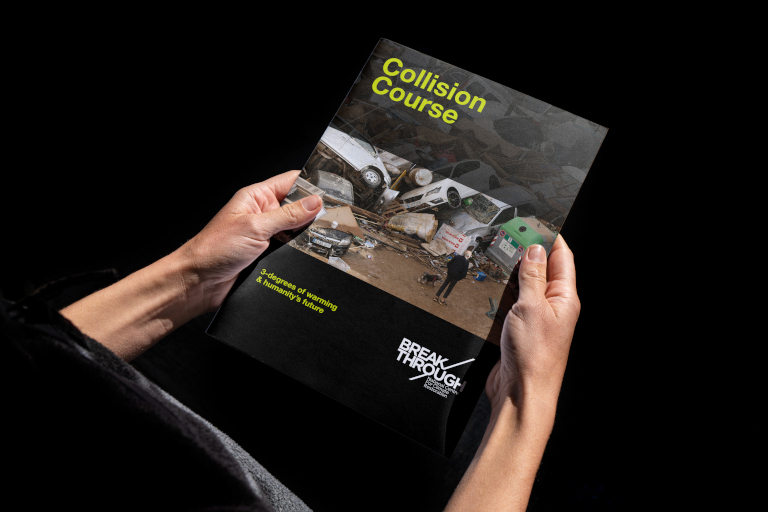
This article appears as the concluding section of Collision Course: 3 degrees of warming & humanity’s future, recently published by Breakthrough.
“The problem is that the status quo is a suicide. Those (Paris) commitments, even if fully met, would lead to an increase in temperature […] above 3 degrees which would mean a catastrophic situation.”
— UN Secretary-General Antonio Guterres, May 2019
 |
| Download the report |
In 2005 James Hansen, sometimes dubbed the “godfather” of modern climate research, warned that humanity was “on the precipice of climate system tipping points beyond which there is no redemption”. Nineteen years later, we are heading for eye-watering social and ecological disruption, and civilisational collapse. Cities and regions and nations will drown and desertify. There will be an unrelenting global food crisis. Billions will be displaced and the global economic and governance systems of contemporary society will not work.
In practical terms, the world has reached 1.5°C of global heating, the rate of warming is accelerating and will likely continue on that path for several decades, especially given the failure so far to bend the emissions curve down fast. That means 2°C by 2040 or shortly after, and the emergence of vast zones of unlivable heat two decades after that on the present course of grossly inadequate action. Tipping points have been passed or are close at hand for some of the biggest elements of the climate system, including polar ice sheets and vast forest and permafrost carbon stores; and system inertia and hysteresis make preserving and restoring those systems very challenging. Scientists are increasingly alarmed that we may be heading towards AMOC collapse by mid-century.
Any rational response would be an emergency “All hands on deck” rallying cry. Reducing emissions, even very fast, is not enough to stop the systemic changes that are under way. Drawing atmospheric carbon dioxide levels back to safe, near pre-industrial levels, is a necessary but slow process; and in the meantime actively cooling the planet must be on the agenda if it can be done safely. This is what the Climate Crisis Advisory Group has termed a “Reduction, Removal and Repair” strategy. This approach is also discussed in our briefing paper Accelerating climate disruption and the strategy to reduce, remove and repair.
Avoiding civilisational collapse means governments and nations making climate the first priority of economics and politics, especially for the world’s largest and high-polluting economies. It would mean making human security, not national security, the focus of geopolitics. It would mean the rich providing the capacity for developing nations to make a fast transition. It would recognise that disruption is inevitable, dislocation is necessary and this is not a period for business and politics-as-usual.
But instead of honestly facing this truly existential threat, nations are all-in on a process of sustained collective denial via the United Nations Framework on Climate Change, and its annual hi-viz global meetings known as the Conference of the Parties (COP), where thousands of the global policy-making elite — both government and corporate — have gathered every year for three decades. The process has failed, as it is designed to do. Every country, including the petrostates, has a veto over every outcome, and it shows. The original goal of “preventing dangerous anthropogenic interference with Earth’s climate system” has been left by the wayside.
The COP climate policy-making paradigm, the “official future”, is crafted to fit the desires of global capital and the fossil fuel industry. Change paths must be incremental and non-disruptive, and certainly should not strand large amounts of capital. Action is delayed with long-term, non-enforceable goals such as “net zero by 2050”, which remains common currency despite the evidence that such procrastination is facilitating a path towards collapse, not preventing it. The “net” in practical terms means “not” zero.
The primary emphasis is on carbon-price or emission-cap market mechanisms which have devolved into rorted offset schemes and the like. Cheating occurs by systematically underestimating national emissions, and sectoral ones such as gas industry methane emissions. Plus the technological cargo cults, such as carbon capture and storage which Prof. Kevin Anderson calls ”a rhetorical device for maintaining business-as-usual and delaying real-world emission cuts”.
Behind the scenes, rhetoric rarely matches reality. The New Republic reported that: “An October 2020 email exchange between Shell executives — unearthed as part of an investigation by the US House Committee on Oversight and Reform — noted that the company’s net-zero talking points had ‘nothing to do’ with the group’s business plans.”
Then there is the quasi-scientific excuse for continuing with high emissions: that of “overshooting” the goal and later getting back to cooler conditions, except the path back may not be possible in the way imagined by policymakers. And the economic models — Integrated Assessment Models — used to justify this procrastination which are barely credible and make leaps of faith and assumptions at odds with real-world conditions.
This “official future” is one of confusion, delay, fake solutions and fake news carefully manicured by the fossil fuel industry over many decades. Many governments — in Australia, the UK and the USA, for example — remain captured by fossil fuel interests. In Australia, recent egregious example include the Northern Territory Chief minister telling anti-gas protestors that “you are wasting your time”; South Australia’s energy and mining minister telling an oil and gas industry conference that his state government is “at your disposal”; Western Australia’s environment watchdog stripped of power to assess big polluting projects; and the Australian Government’s strategy that “new sources of gas supply are needed”.
The “official future” which is performed each year at the COPs, and every week of the year in parliaments and markets, is a fig leaf for state and corporate failures of imagination and the need to think the unthinkable. The most unthinkable proposition is that large-scale disruption is now inevitable because markets have failed on climate risks. When all is said and done, the choice is social collapse and economic disruption due to the failure to act fast enough, or economic disruption as a necessary consequence of emergency-level fast change, no matter how politically unpalatable that may appear to be. There is no third way.
This is a structural problem, because the physical changes in the climate system are often non-linear and hence difficult to project, but markets crave stability and fear disruption. Climate damages are radically uncertain (basically, unquantifiable) so that cost-benefit analysis — a basic tool of private-sector risk management — breaks down. The risk cannot be priced. In circumstances where the climate risks are global and existential, markets are unable to fully assess the risks and mitigate them. Just as they can’t for other large-scale and unquantifiable risks, such as war, pandemics, and the threat posed by AI.
In 2011, Paul Gilding’s The Great Disruption concluded that it was an illusion to think the contradictions can be resolved within the current economic frame and that disruption and chaos was now inevitable as system failure occurs. It laid out the reasons to “address the emergency with the commitment of our response to WWII and begin a real transformation to a sustainable economy.”
Five years earlier, Nicholas Stern had said that “paths requiring very rapid emissions cuts are unlikely to be economically viable” and disruptive because “it is difficult to secure emission cuts faster than about one per cent per year except in instances of recession.” Analyst Alex Steffen concludes that:
It is no longer possible to achieve [an] orderly transition, to combine action at the scale and speed we need with a smooth transition and a minimum of disruption […] We are not now capable of designing a future that works in continuity with our existing systems and practices while producing emissions reductions and sustainability gains fast enough to avoid truly dire ecological harm. This is an option that no longer exists.
And the risk intelligence company Verisk Maplecroft assesses that “there is ‘no longer any realistic chance’ for an orderly transition for global financial markets because political leaders will be forced to rely on ‘handbrake’ policy interventions to cut emissions.”
Even though Sir Nicholas Stern named global warming as the “greatest market failure” in history, governments have been ideologically reluctant to act sufficiently to correct this greatest distortion of the market. Our political leaders, who should be honestly assessing the risks, and initiating or joining their populations in a difficult but necessary conversation about why climate heating is driving us towards unimaginable levels of social breakdown, are instead looking the other way. The public conversations about looming social collapse are avoided at all cost, so a discussion about necessary disruption never happens.
In Australia’s case, the current government has locked away the nation’s first climate and security risk assessment because its public release would make a mockery of their dance of death with the fossil fuel industry to expand coal and gas production.
Twentieth century history teaches us that economic crises leading to sustained stagnation is fertile terrain for authoritarian politics; a lesson reflected in events this century too, where authoritarian leaders including Donald Trump have downplayed or denied the climate crisis. China is the notable exception. And there is evidence that global heating disruption creates fertile ground for political strongmen to come to power. As a deepening climate crisis leads to a deepening economic crisis, what is the path to avoiding the rise of authoritarian political leaders and their climate denial in a feedback loop that will only quicken collapse?
In such circumstances, the primary responsibility and leadership role in any nation must be shouldered by government. Only the state apparatus has the whole-of-nation, whole-of-system powers and capacity to respond with the interests of the people as a whole at heart. But the biggest polluters and sources of fossil fuels are either petrostates or governments captured by the fossil fuel industry.
Instead of state leadership, writes George Tsakraklides, we have reached a point where “the full-time job of government, corporates and the media is now to simply keep everyone convinced that this self-annihilating civilisation is somehow supposed to make sense. Well, it doesn’t, as we are all finding out… as we enter a bumpy, bruising, bloody descent towards an economic, cognitive and spiritual abyss.”
Boris Frankel, in his Fictions of Sustainability, has pointed out that in the present economic circumstances — low growth, stagflation, disruption — the material needs of decarbonisation cannot be absorbed by growth, but only by reallocation of financial and physical resources. He says that if there are no major technological breakthroughs in the next decade (especially regarding decoupling), then climate disruption and resource depletion will force governments to take emergency action and scale back production in the face of systemic breakdown.
Climate disruption and resource overuse will also destabilise markets, resulting in continuing low growth and growing inequality. Markets have and will likely continue to fail to respond to the twin crises, and instead creeping financialisation — credit-fuelled consumption, speculation in everything from shares and real estate to NFTs and crypto currencies, and an increasing burden of debt and debt servicing — will continue to be the hallmark of neoliberalism’s pernicious hold.
If resources are to be redirected to economic transition and equity needs, there is a crying need to curb the power of financial capital and rechannel current economic behaviour away from speculation to socially-useful ends: a liveable and biodiverse planet. Against this possibility, business has strongly opposed state intervention as a guiding principle of its behaviour, and succeeded in blocking state leadership of the climate emergency.
Australian financial commentator Alan Kohler once quipped that that politics is a sideshow, as central banks run the global economy and Silicon Valley governs society. The 2024 victory by Donald Trump and his Silicon Valley-annointed Vice President JD Vance fits the bill. Their agenda absolves governments of climate responsibility, and is a direct assault on global efforts to prevent and mitigate the crisis.
In this time of great political volatility in America the challenge to mobilise the world in time to avoid the collision is set to be severely hindered, leaving our future hanging in the balance.
The urgent need is to take back and rebuild state institutions destroyed by neoliberalism in order to redirect production to socially-necessary goals — decarbonisation and cooling, and basic public needs including secure food and water, and health, education and transport — to plan and manage the transition and adjustment, and to curb the destructive path of financialisation. This would be a massive politically-directed reallocation of resources not only in the OECD, but in China, India, Nigeria and more. In the first instance this is a question of what needs to be, and can be, produced within resource sustainability and safe-climate boundaries.
There is a battle for the role of the state, with democratic community movements worldwide — including citizens, students, the labour movement, grassroots organisations,, and a myriad of other diverse constituencies — demanding that the state act to overturn deregulation’s hegemony. And just as proposals focussed on Green New Deals and market-driven growth have failed to deal with systematic market failure on climate risks and resource depletion, so also enhanced social expenditure will also fail if state leadership does not provide a path out of the climate and ecological crises via an emergency mobilisation.

Comments
The existentialists of mid-century France, Sartre and Camus, were not the only hammers to hit the nail on the head. But they got it right too. There is no escape, not exit, from the absurd boobey traps of the mind. Kabuki Theatre, Greek dramas, Shakespeare, Conrad and a host of others, have been shouting from the rooftops for centuries. But too few listened. From Pope Gregory to Lawrence Kohlberg, moral dilemmas have been diagnosed and laid out in explicit detail. Yet, IMO, we can ruefully thank the fiction of ancient religions for their 'triple whammy gods' watching over all of creation for their deceptively simplistic 'get out of jail free' card of mea culpa. Being a literature scholar as well as a scientist, long ago I found W.B. Yeats' The Second Coming to be more than prophetic. Now, for more than a century, the Rough Beast has shuffled toward Bethlehem, and is now at the gates of the city, and it needs no key to enter. The walls are crumbled, the gate rusted, the lock brittle and quiescent in the hands of the Beast as it pushes its way inside. It finds only deranged, sick, deluded and suffering human flesh. Those indifferent desert birds are, thankfully still here. As I write, I watch hundreds of them feeding and drinking outside my window. Years ago I made the decision to accept my human fate, but not to include Earth ecology in that nihilist outcome. I created two heated baths and 15 feeders, and I feed about 400-500 lbs./month. Avains are what human should have become, and since I am a jack Buddhist, I can wish for another lifetime as any one of them. I often hear humans exclaim that we will perish but the Earth will survive. I find that utterance sadly in line with the cavalier ignorance of a hungry zombie. The physical ball of Earth may survive, but 66 million years of biotic life force, in all its exotic splendor, may not. These birds have not participated in this trainwreck, along with all other non-human biota, so humans will indeed deserve the Inferno they have created for themselves. But to ravage all beauty and truth is not only unforgivable, it is deserving of a forever extinction of Homo sapiens, the good along with the bad. 'Trust me, the check is in the mail, and only I can fix this' is the death rattle of our species.
Insufficient breadth. The piece would be more useful if it asked WHY there has been such persistent failure, and if it recognized that the climate crisis is only one of several existential crises bearing down on us. The rate of decline of species–numbers of populations as well as entire species lost to extinction–is as rapid and as consequential as the climate crisis–even if you care only about humans, we are animals dependent on ecosystems, we won't survive if too many sections of the web of life are destroyed. Then there are the rather recently recognized dangers from plastic pollution, PFAS, glyphosate, many pesticides…and we are no closer to reining in these threats than the climate threat. There are also threats from nuclear weapons, on rapid increase and weaker controls, weaponized robots, constant surveillance…and it's important to recognize that all these things are connected causally. The reason governments consistently make the worst possible decisions is that they are run by corporations, not people.
Sure, there are presidents and prime ministers and senators and MPs who are human, just as human spokespeople announce corporate policies–but these people CANNOT do anything to threaten corporate profits, no matter how desperately necessary, or they'll be yanked out of their seats and replaced. It's obvious how this works for CEOs, but even for "your representatives"–ha!–they get reelected by spending lots of money on campaigns, and they get that money from special interests, which must be repaid in political favors–favors which ALWAYS come at the expense of the common good. As long as this system holds sway–reinforced by the corporate "mainstream" media and control of social media by psychopathic billionaires–governments CAN'T do the right thing and never will. Merely lobbying and campaigning for supposedly better candidates is a complete waste of time. Either we find a way to upend the system, or we must focus on building alternatives at the local level–because that's where we have the most power, because this will best protect us through the coming collapse, and because withdrawing support for the Machine comes along with building the alternative…and we may be blocked even at the local level from creating communities not dictated to by corporate machines, but once collapse sets in, that blocking will likely evaporate.
In your laudable list of other elements of the poly crisis, you left out perhaps the biggest one: the imminent collapse of the master resource for modern civilization: fossil sunlight.
This is not just willing disbelief; it's active subterfuge.
While civilization's proponents tout our ever-increasing growth, they neglect or even disguise some key facts. In the zeal to rebut the "peak oil" crowd, it must be noted that a barrel of oil may contain upwards of 10% less energy than it did just ten years ago.
In that time, the composition of a "barrel of oil" has changed markedly. The preponderance of light-grade fracked oil has reduced the energy content of the average barrel of oil, but illusory things like "refinery gain", natural gas liquids, and even biofuels have been added to the average barrel of "oil" — some of those biofuels actually use more energy to produce than they contain.
There is evidence that the party is coming to an end. Conventional oil production has been in decline for some seven years. Only US fracking has been propping up the total, and it looks like it is beginning it's decline . As the US fracking decline accelerates, conventional oil producers — themselves in decline — will be reticent to export, needing their own oil for their own populations.
Until we do away with the notion that "growth is always good", we are doomed. When this happens to a human, they die young, like Andre the Giant, who suffered from acromegaly and died at 46.
Somewhere in hell, a puff of steam is all that remains of a snowball.
As T. S. Eliot opined, 'Not with a bang, but a whimper.' I had a bumper sticker on my truck for a long time, for many to see, but now it has totally faded and is blank. It read, accredited to Napoleon Bonaparte – Religion is what keeps the poor from murdering the rich. Soon enough the rich hammers will be beating each other to death. They always do, but now there is nothing left in the pot but toxic scraps. Hence the following – The seven deadly sins were first compiled by Pope Gregory I around the year 600. They are pride, greed, lust, wrath, gluttony, envy, and sloth. Wiki The petty oligarchs and their rockets say it all. Maybe they read 'The Marching Morons' by Philip K. Dick. But instead, it is they who imagine themselves leaving Earth for Blade Runner's off-world paradise.
I can't find that book. Did you possibly mean a book of that name by "by Cyril M. Kornbluth"?
No, I remember it well. It was a short novella, probably circa 1975, and appearing in an anthology of sci fi short stories. It involved a very stressed and overworked intelligencia, working to keep the wheels on and the lights bright in a world of moronic consumption. They know they are losing the battle, so they collaborate, and come up with a scheme – find the worlds best salesman, and set him to task sending 95 percent of Earth’s population to a non-existent planet via rocketry, clearing the Earth from the consumers and giving it a long rest. They contract with a used car salesman, who demands that he be made king of Earth in exchange for his success. It works, billions of humans fly off into empty space to die dreaming of pleasant new beginnings. The salesman becomes king, and is then grabbed up and sent off into space on the last rocket available.
Ah, an anthologized short novella.
That might explain why it doesn't show up on any lists of Dick's books.
No doubt the issue. A story so pertinent today, but with a different twist. Deportations, not of working folk, but of lazy freeloaders who do all the buying and energy wasting and trash throwing.
To be fair, the author picked a volume of thought/information he thought was cogent enough to make his points, as do you. All of us, or most, who read here know the hammer has dropped. All 'things' outside corporate/blue blood/neubo-riche/militarist monarchy are nails, and 0.01 – 1.0 percent of living human flesh are hammers, some huge, some for driving pins into cushions. However, we are not yet dead, so I would suggest we stop picking on each other over minutia when trolls the size of mountains are goose-stepping across the planet right now. What both you and the author conclude are very true, collapse is not only inevitable but tragically necessary. Perverse sadism became popular among elites a long time ago. Unlike Canis species, and others, humans are less packlike than they imagine. Bad blood in bully positions has been wiped out by committee purging for millions of years among wild and intelligent creatures. But the advent of moralizing human religions, all of them built on double standards, infused into human governance a 'get out of jail free card' for psychopaths. For a long time now, being kind and tolerant concerning 'exceptions' to sensible rules has rendered a human world filled with selfish bullies. As an ecologist, I long have puzzled at the logic that surrounds the need for Homo sapiens. In fact, to find a single planet among billions that can host energetic lifeforms is preposterously rare, so it appears that humans cannot even follow their own valuing logic, a logic they robustly applaud, hence the designation 'sapiens.' As much as I appreciate many humans I have met across the lifetimes, it is beyond conclusion that this species is anathema for graceful biotic existence. If any of us survive the yet unimaginable trainwreck we are now propelled in, it will be in a future that only sci writers of the past 70 years have already positied. Those make 'A Boy and His Dog' look pleasant and inviting.